
Ghotit offers it’s Microsoft integrated Assistive Technology plug-in for just 9 cents a day…

According to Wikipedia “Assistive technology or adaptive technology (AT) is an umbrella term that includes assistive, adaptive, and rehabilitative devices for people with disabilities and also includes the process used in selecting”.

From this definition it is clear that assistive technology is a technology which aims to help a targeted group of people (this technology might never be adopted by the general population).

The costs of Assistive Technologies, specifically those targeting people with dyslexia, can reach hundreds of dollars. If a guarantee can be given that an assistive technology solution would result in dramatic writing improvements– than even such a high price of several hundreds of dollars would be worth it. As a person with dyslexia, I know that dramatically improving ones’ writing is an invaluable benefit. But the truth of the matter is that not all assistive technologies are the same, and not all dyslexics are the same. Therefore not all writing assistive technology solutions can deliver on their promise to all dyslexics.

As a dyslexic who has spent in the past thousands of dollars trying to obtain the “right” solution that will improve my terrible writing and spelling, I am familiar with the disappointment when a writing assistive solution that costs close to a thousand dollars, simply does not deliver any real value.

Ghotit writing assistive technology was developed by dyslexics, for dyslexics. As one of the founders of Ghotit, I can confidently say that I have seen no other product in the market that delivers the writing improvements to dyslexics as does Ghotit. However, as stated above, not all dyslexics are the same. Ghotit understands that and is offering Microsoft integrated plug-in for extremely reasonable prices…

So can assistive technology for people with dyslexia be cheap? Yes, go to Ghotit and see how you can purchase Ghotit for only 9 cents a day…

As long as I can remember myself I have always been good in solving mathematical problems.  I “credit” my advanced problem solving skills to my dyslexia, as I have a very good visual grasp of problems and their solutions.

I remember my school math classes when the math teacher started teaching a new topic. I was always one of the first ones to understand and solve the new problems. However, from that point onward I would begin to get bored, and instead of listening to the teacher‘s description regarding what was the structured algorithm to solve the problem, I would get bored and start day dreaming…

For every new problem that was presented; I set off to solve the problem and develop my own algorithm. I did not learn or deduce any formal methodology to my intuitive problem solving capabilities.  More so, sometimes even though I solved a problem correctly, the teacher would take off points for not providing a structured explanation of my work. I remember quite a few arguments with teachers explaining to them that what was important was the fact that I got the answer correct; that it did not matter the method that I used to solve the problem.

However, as time went by, and the problems got more complicated, I found myself falling behind. My classmates, though not so bright problem solvers, had learned the structured methodology and techniques to solve specific problems. I however continued to develop new algorithms for each new problem, sometimes solving the complicated problems correctly and sometimes not. Since I did a very poor job of documenting the steps of the solution, I usually got full credit deduction for a wrong answer. I did not provide the teacher the appropriate description that proved that though my algorithm of solving the problem was correct; the incorrect answer was due to an insignificant calculation error.

Today, as an adult dyslexic and parent I understand that having good problem solving skills is not enough.  It is important that you learn structured methodologies to solve problems. This may not be the natural course of action for some, but adopting structured and disciplined learning processes becomes critical as you advance in your studies and academic challenges.

I recently read an interesting article called “A rose is a rose is a flower” (http://www.thehindu.com/arts/magazine/article881892.ece). The article discusses the pros and cons of being labeled as a dyslexic.

The “pros” – in many cases the diagnosis of being dyslexic, provides the reasoning of why an intelligent adult or child is under-performing in school or in work. Suddenly behavior, that seemed inexplicable to an employer or parent not familiar with dyslexia, is explained. Not only that, once diagnosed correctly the appropriate instruction and assistive technology may be implemented to assist the person with dyslexia.

The “cons” – the dyslexia label brings the disability into focus, also at times when it is not necessary to highlight the disability. As quoted from the article “a person with a label has to be extremely mindful of ‘minor failings’ as all his behavior is perceived through the lens of his disability.” Giving people one-dimensional labels may result in disregarding personal differences and strengths. “While we readily accept that ‘normal’ kids can be quite different in terms of their personalities, preferences and proclivities, we tend to assume that all children with a particular clinical tag (e.g. dyslexia) are alike.”

Do the pros overcome cons in dyslexic labeling?

Well, in my opinion, it depends on the situation. In a supportive school environment, where the main objective is to improve the learning abilities of a dyslexic, it should be beneficial to be classified as dyslexic. In such an environment, the school, together with the support of the parents, will work out the best program and learning environment offered by the school to the dyslexic student.

However, in a work environment, where the main objective is to optimize the productivity of the employee, being classified as a dyslexic may be harmful. The main objective of a modern workplace is not to optimize the work environment of a dyslexic person, but rather to ensure that the person filing a given position is providing maximum value. In such environments, being categorized as dyslexic may not benefit the person with dyslexia; rather this categorization may result in unnecessary discrimination against the person with dyslexia.

Bottom line

I think that at the bottom line it is up to the dyslexic/ dyslexic parent to assess if it is advantageous or disadvantageous to be categorized as a dyslexic. If it is advantageous, then sure, let the word out, and try to maximize the benefits of being labeled with dyslexia. However, if it is not, and you feel that being categorized as dyslexic may be used against you, then withholding the fact that you are dyslexic should be the right way to go.

Some people view Twitter as the global internet chat room. Following that paradigm, if you track and listen to what is being said in Twitter you can get a good feeling of what the global community has to say about a particular topic…

So last week I decided to listen in, and hear what people have to say about dyslexic people. Besides the professional tweets, tweets about how to deal with dyslexia, I came across a more layman channel that used the term “dyslexic” in more mundane, day-to-day expressions.

Here are some of the expressions relating to dyslexics that I came across:

-          “If life hands you melons, you might be dyslexic”

-          “I just got dyslexic for a second. Tried to read a tweet and I read it wrong like 5 times.”

-          “My inability to tie a necktie leads me to wonder if I’m dyslexic?”

-          “That’s weird…I was like, dyslexic with SOUND!”

-          “I spent 20 minutes doing Running & Sweating Like a dyslexic on countdown”

-          “Most color blind people can see colors, they just mix them up. Shouldn’t they be called “color dyslexic”?”

-          ”Don’t buy a 70,000 car before you buy a house. That’s so dyslexic”

-          “Is your kindle dyslexic? Is that’s what’s wrong?”

-          “The best part about being 33 is that for the first time since I was 22 dyslexic people know my real age.”

-           “This new twitter is making me feel dyslexic, like my feed should be on the right side or something!”

The most popular re-tweet was “If life hands you melons, you might be dyslexic”. This sentence is actually a pun on a popular saying “If life gives you lemons make lemonade!” (which translate to if life is bitter, make something sweet). The pun here is on the word “lemons” – as people with dyslexia tend to jumble letters, so switching the word lemons to melons means you might be dyslexic… This tweet I found amusing and witty. (BTW – there is a facebook page called “If life hands you melons, you’re probably dyslexic” – with 11,281 people who liked the page (myself included)…

However, if you look at the other tweets, it seems that people were using the term “dyslexic” as reference to something or someone who is slow, broken, unable to perform simple tasks, verging on the stupid. To me that was worrying, because it seems that there is awareness and adoption of the term “dyslexic” by the general public, but in most cases the word “dyslexic” was being used in a negative connotation.

Such abuse of the word “dyslexic” may inadvertently lead to an unwarranted prejudice against people with dyslexia…

As I have no formal answer of how to change the perceived impressions of dyslexics by the general public, I will end this blog with a request from readers’ insights and a link to the video with a twist on the lemonade saying:

[youtube=http://www.youtube.com/watch?v=VfnHJrU6uEo&fs=1&hl=en_US]

Bookmark and Share

I was sitting at the hairdresser’s shop, reading an article in a women’s magazine. Suddenly I realized: This is my child! The article is talking about my child. Each sentence re-enforced this realization. They are talking about my son.

The article was about dyslexia, describing the characteristics of dyslexic children. I don’t remember the exact details of the article, as 25 years have passed since.  However, this was the first time I ever heard of dyslexia. This was the first time I learned that Reading and Writing, these learned skills, skills that almost everyone succeeds in mastering, may be very difficult to very intelligent people diagnosed with dyslexia.

Unbelievable. This piece of information was the most important piece of information I have ever received in my life. Now I understood, that my son was not lazy, my son needed help. Till then I tried to teach my son by forcing him to sit down and repeat again and again words and letters. That was not easy and in some way looked cruel. But what was the alternative? Can a person succeed in our world without the knowledge of reading and writing?

25 years ago my son, Kevin, was 10 years old. At that time, awareness about dyslexia was quite low. I remember talking to my son’s teachers and educational counselors and being amazed about their ignorance on this topic. How can it be that a women’s magazine publishes information about learning disabilities that professional educators are not familiar with. The best were those teachers, principals and psychologists who admitted their ignorance but were eager to learn more about dyslexia. The worse were those educators who pretended to know everything or were simply indifferent to the condition. Against these people you have to decide to fight.

I hate arguments and conflicts but sometimes you have no choice. After all, Kevin is my son, and my son must know that his parents fully support him and will fight for him.

My husband and I embarked on a battle to educate my son’s school about dyslexia. It was no easy tasks, and sometimes I wondered what happens to all those children whose parents do not know how to persistently argue a case until it is won…

After a long battle we were able to adjust the learning conditions of my son in his school. At certain points we realized that our son understood his parent’s defense incorrectly. He began to behave as if he was granted permission to do in school whatever he wanted, avoiding assignments and tasks that he did not wish to perform. I was informed that he was coming in late to school almost every morning. Coming late to school is not one of the privileges a dyslexic child is entitled to. It is important that you fight for privileges that are required to compensate for your child being dyslexic, but at the same time make sure that your child is not abusing these privileges to avoid his responsibilities.

My son’s son (my grandson) has recently been diagnosed with dyslexia. When looking back, I feel that some conclusions may be drawn from my experience of raising a dyslexic child:

1.       Look at the truth straight in the face. If you suspect a problem, consult a good and reliable therapist. Consulting does not tag any child in a negative manner.

2.       Although your child may be treated by the best professionals, keep being involved with his progress.

3.       If your child experiences misunderstandings at school and you are expected to intervene, examine all facts and sides carefully, before forming an opinion.

4.       And last: although dyslexic children may reach high achievements, they usually cannot overcome all spelling errors from appearing in their writings. Here is where assistive technology (like Ghotit Writing Assistive Technology) offers its value.

Ghotit hosts from time to time guest blog posts about dyslexia.

The writers of these posts may be dyslexics, dyslexic family members, dyslexic tutors, teachers, assistive technology specialists or any other writer as long as the post provides quality information about dyslexia.

This is the second hosted post by Mary, a parent of a dyslexic.

Bookmark and Share

It is inevitable; a child with dyslexia will sooner than later be “tagged” in a regular school as a student with problems by both the school staff and his classmates. The school staff will tag him as “problematic”, as he will require additional assistance, access to assistive technology solutions, extra exam time etc. His classmates will tag him as different, from the first time that he is requested to read out loud in the classroom. The child with dyslexia will most probably make such reading mistakes which will result in laughter or degrading remarks by other children. Within such an environment a dyslexic child’s self-esteem will be negatively affected.

So the question arises:  How can parents assist their dyslexic child’s self-esteem within a system that clearly marks a dyslexic child as a person with problems?

(Note: I am not a professional educator or psychologist, only a dyslexic person who studied within regular school systems and who was tagged early in school as a student with problems.)

These are couple of suggestions I believe that may improve the self-esteem of a dyslexic child:

1)      Try to help establish for your child a strong social standing. This is more applicable for younger students, but I believe that parents can definitely influence a young students’ social standing. Try to identify two or three potential friends that have a strong social standing, and that the child has good communication with, and be proactive in joining your child with these children. As a parent of 3 children, I have witnessed the fact that parents of young children can definitely influence the social standing of their young child. Initiate communication with these potential friends’ parents, invite these kids over, and make sure that they have a great time when they come over. Initiate fun and unusual activities that will make your child’s potential friends very eager to come over, spend time and get to know your child as the wonderful potential friend that he really is. Connecting your child with well liked children in school, will help him network with other children, establish his social standing and lay the foundation of a secure social base.

2)      Assist your child in identifying and demonstrating his unusual thinking. Research has demonstrated that people with dyslexia are “out of the box”, innovative, problem-solving thinkers. This may be a key differentiating characteristic for a dyslexic person, and as such should be leveraged and mastered in school. If your child is interested in unique topics, then encourage this unique knowledge, and work with him how to demonstrate/boast of this knowledge in class. Volunteer as a parent, to present to the class, together with your child, his unique topics of interest. For example, if your child is especially interested in aviation, and has above average knowledge on this topic; build together a presentation/activity that displays this knowledge. Let the other kids know that your child is very knowledgeable on these “cool” subjects. When your dyslexic child is older, encourage him to take classes in areas that he can boast of his unique way of thinking. Encourage your child to take the time to assist other children that are experiencing challenges in such topics (just as a side note – I met my wife in University when I offered to study with her a Macro-economics class – a subject that to me came very easy, and which I could very logically explain). By helping his schoolmates, he will not only feel good about himself, but he will be appreciated by his school peers.

I would love to hear your insights on how best to assist your dyslexic child’s self-esteem within a regular school system? Love to read your comments…

(FYI – Webster’s definition of self-esteem: “a confidence and satisfaction in oneself”)

Bookmark and Share

I remember once studying with a non-native American who came to the US as a teenager. Though his English accent was perfect, when speaking he had quite a lot of grammar errors. I remember that whenever he was unsure of his grammar, he used to apologize, and quietly explain that he was a non-native American. When I asked him how come he keeps on repeating the fact that he is a non-native American, he answered that he would rather people know that he is a non-native American, then have people think that he was an uneducated or unintelligent person, resulting in poor grammar.

I recently read in a blog a suggestion for people with dyslexia or dysgraphia to add to their email signature the fact that the email writer has dyslexia. This in order to explain why there are so many spelling mistakes in the email…

As a dyslexic and terrible speller, this got me thinking, WHAT IS PREFERABLE?

  • For the mail recipient to potentially conclude that the email writer (“me”) is not very intelligent. FACT OF LIFE: Some people will conclude that a person with poor grammar, poor spelling, poor vocabulary (let’s remember that many times the written vocabulary of a dyslexic may be quite poor, because a person with dyslexia tries to write only the vocabulary that he has some confidence that he can spell correctly)… is simply not very educated or else not very intelligent.

  • For the mail recipient to have the knowledge and understanding that the email writer is dyslexic. FACT OF LIFE: Some people, mainly those ignorant of what dyslexia is all about, may associate dyslexia to a severe disability that the writer is suffering from.

So what do you think is preferable?

For me, after sending thousands of horribly spelled emails in my life, I came to the conclusion that both options listed above  are bad- a classic “lose-lose” scenario. A person with dyslexia must make the effort to spell correctly. Advanced writing assistive solutions, such as Ghotit, empower a person with dyslexia to produce correctly spelled text, removing from the table this whole “is it preferable to be  tagged as a Dyslexic vs Unintelligent person”  issue…

Bookmark and Share

Millions of kids have recently started going to school worldwide, about 10% of them suffering from dyslexia.

As the year unfolds, some parents of first and second graders will see for the first time the written text that their son or daughter has just written, and will ask themselves “ What is this? What gibberish has my son or daughter produced?”

For some of these parents this will be the first indication of their child’s writing disability, and their initiation as dyslexic parents…

As a lifelong dyslexic and a dyslexia advocate, I would like to provide these parents my non-scientific definition of  “dyslexia spelling” – spelling produced by dyslexics…

Dyslexia Spelling = Phonetic Spelling + Creative Spelling

What is Phonetic Spelling?

When you’re dictating a word and tell your son or daughter that he should write what he hears, a child, including a dyslexic, will attempt to map the sounds in the words to the sounds of the letters.

However, English is not a phonetic language. There are a very large number of English words where there is a gap between how the word sounds and how the word is actually spelled. Not to mention, there are many times multiple correct phonetic options to a sound (for example: k , c, ck, and qu all sound about the same)…

What is Creative Spelling?

Given that English spelling is not phonetic, and per each sound may have several spelling options, a lot of correct English spelling is dependent on the visual memory of a written word. If you have good visual memory of words, you will be able to spell a word correctly simply by writing it down, and from memory deciding if this is the correct spelling.

But people with dyslexia, have very poor and consistent visual memory of spelled words, and therefore can hardly rely on their visual memory of words.  (see my example of how I spell the word “unfortunately” in a previous Ghotit Post – My Dyslexia and Phonological Processing.)

Not to mention that dyslexics sometimes simply confuse the direction of letters, and though they meant to write the letter “b” actually end up writing the letter “d”…

I term all the above spelling challenges as “creative spelling”. It is “creative” in the sense, that given that a person simply has no idea of how to spell correctly certain syllables of a word, he creatively makes them up as he writes. And each time he “creates” a word’s spelling, it usually ends up as a different spelling creation.

Can a regular spell checker correct dyslexia spelling?

If English was a phonetic language, then regular spell checkers who have implemented phonetic spelling rules would probably provide some value for dyslexics with poor visual spelling memory…

However, English is not a phonetic language, and therefore the “creative spelling” of a person with dyslexia must be taken into account in a spell checker. However the “creative” spelling of a dyslexic is basically “noise” and therefore any computerized program, such as a regular spell checker, that tries to correct a single word at a time (and not based on the context of the sentence) is doomed to fail… That is why Microsoft spell checker many times simply fails to correct a heavily misspelled word written by a dyslexic.

Context-based spell-checkers for dyslexia spelling

Here is where benefits of a context spell checker such as Ghotit’s Contextual Spell Checker come to play. Context-based spell checkers not analyze directly the “creative spelling” of each word written by a dyslexic, but rather based on the context of what was written, intelligently offers corrections, predicting what was actually intended to be written.

Bookmark and Share

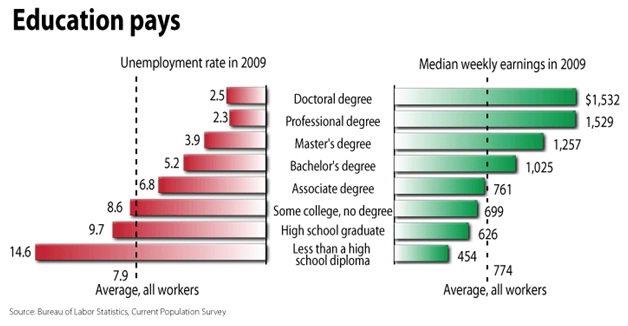
Studies show that education pays off in terms of employment and earnings.

Here is a study produced by the US Bureau of Labor Statistics that clearly demonstrates that a higher education, on average, pays off:

The graph above demonstrates that there is a strong positive correlation between education and income; and a strong negative correlation between education and unemployment. In order words, a person with a higher education, on average, will have higher earnings, and less probability to be unemployed then a person with a lower education. The statistics displayed above are true, on average, for the entire population.

However, do these same statistics apply for people with dyslexia?
I believe not…

I remember reading in the past a UK study that claimed that the gap of unemployment between a person with dyslexia and without dyslexia rises with increased education (sorry – could not find the link of the study – if anyone can help let me know). In many ways these findings make sense. Dyslexics receive support from their families and teachers and government aid during their school years, to ensure their academic success. But, once they leave the school gates, they are usually left alone with their reading and writing disability.

In many countries there is already a high awareness to learning disabilities and dyslexia, with government aid being offered (e.g. Individuals with Disabilities Education Act (IDEA)). These government intervention projects provide proactive aid to dyslexic students to graduate from high schools and universities. However, there is minimal or no official support offered to graduating dyslexics, promoting those same people who were aided in schools, to obtain and maintain a job.

This information presents a real challenge for educators and decision makers. In order to help people with dyslexia to succeed in life, on one hand education assistance is required. But on the other hand proactive aid should be offered assisting a dyslexic to obtain and maintain a job.

Only then can education really pay off for dyslexics too.

Would love to get your inputs…

There are pros and cons when considering Word Prediction technologies for people with dyslexia.

The Pros:

-          Using word prediction solutions, dyslexics will enhance their vocabularies by selecting from words that they are unsure of their spelling and otherwise would not have used these words

-          Using word prediction software, dyslexics will feel less constricted and be able to select from words that ordinary spell checkers do not offer

The Cons:

-          If a person with dyslexia (who is a natively bad speller) starts the word with incorrect spelling, then all the word prediction options are completely incorrect

-          It is very difficult for a person with dyslexia to select from the list of predicted words, as being such a bad speller, he cannot directly relate the predicted word to the word of his intention

Experience of a heavy dyslexic (“me”):

As a heavy dyslexic I have always found word prediction technologies quite challenging. My spelling “insecurities” always gave way to complete lack of confidence in choosing a suggested word offered by word predictive solutions. My “spelling” insecurities always led me to hesitate in selecting the correct predictive word. Is the suggested word in par with the spelling of the word I intended to write? Without any other assistance, I either surrendered (and did not select any suggestion) or went to work overtime (by looking up the different suggestions to make sure I selected the correct one)…

There are different views by dyslexics regarding the question “Is Word Prediction Technology Good for People with Dyslexia?” What is your view?

Note: Ghotit offers word suggestions by the context of the sentence and offers also an integrated dictionary and text to speech capabilities to ensure that the word that is being selected is the actual word that was meant to be written.

Bookmark and Share